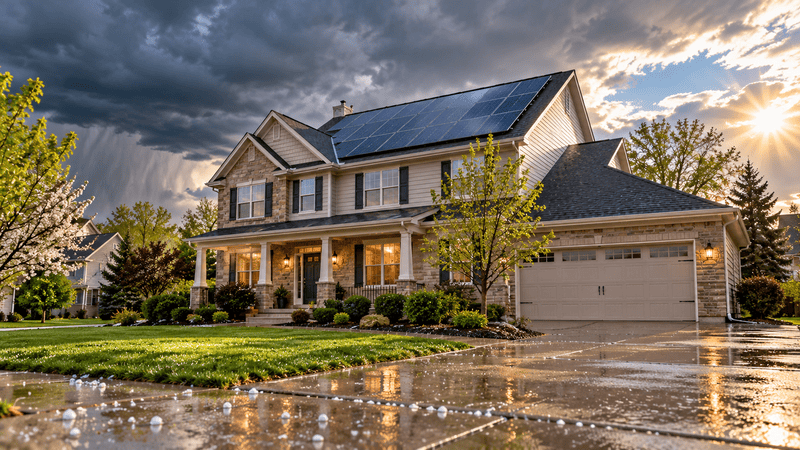
Severe weather season got an early, busy start this month. Tornado watches stretched across the Ohio Valley on March 11, and more damaging storms rolled through Kentucky and southern Indiana on March 15 and 16. Our thoughts are with the communities that were hit hard.
When storms like these hit, we get a lot of the same question from homeowners thinking about solar: “Will my panels survive hail?”
The honest answer: solar panels are built tough, and hail damage is rare. But they aren’t indestructible, and it helps to know what the ratings mean.
How Solar Panels Are Tested for Hail
Before a solar panel can be certified under the international standard most manufacturers use (IEC 61215), it has to pass a hail test. Technicians fire ice balls about 1 inch in diameter at roughly 51 mph at 11 different spots on the panel. To pass, the panel can’t show major damage, and its power output can’t drop beyond strict limits.
That’s the minimum. Many manufacturers test beyond it with larger ice balls at higher speeds, and some panels carry enhanced hail ratings. If you live in an especially hail-prone spot, it’s worth asking your installer about the hail rating of the specific panels being quoted.
The panel’s front surface is tempered glass, the same type of safety glass used in places built to take a hit.
What the Real-World Data Shows
Lab tests are one thing. Here’s what happens in the field:
- In a National Renewable Energy Laboratory (NREL) study of nearly 50,000 solar systems installed across the U.S., the probability of a system being damaged by hail was below 0.05%.
- The same study found that during extreme weather, grid outages are more likely to cause problems than damage to the solar system itself.
- A later NREL study of systems hit by severe weather found that the typical impact was a loss of about 1% of a year’s production. However, systems hit by hail about 1 inch or larger, or winds above about 56 mph, showed more long-term wear afterward.
In other words, everyday hail rarely damages solar panels. Very large hail, the golf ball-sized-and-up kind that dents cars and destroys shingles, can crack panels. That’s the same kind of storm that often means a roof claim anyway.
What About High Winds and Tornadoes?
Panels are mounted to racking that’s bolted into your roof’s rafters and designed to meet local building codes for wind. In typical severe thunderstorms, a properly installed system stays put.
No residential roof system, solar or otherwise, is designed to survive a direct hit from a strong tornado. Flying debris is the bigger risk in extreme wind, for panels, windows and siding alike.
Lightning
Solar systems are grounded according to electrical code, and inverters include protective features. A direct or nearby strike can still damage electronics, just as it can damage other equipment in your home. If you suspect a strike, check your monitoring app and call your installer.
Does Insurance Cover Solar Panels?
In many cases, rooftop solar panels you own are treated as part of your home under a standard homeowners policy, much like your roof. But every policy is different. We recommend you:
- Tell your insurance company when your system is installed.
- Ask whether your coverage limit should increase to reflect the added value of the system.
- Check your deductible and whether your policy has separate wind or hail deductibles.
Keep your installation paperwork and photos of the system in a safe place. They make a claim much easier if you ever need one.
Your Solar Warranty vs. Storm Damage
It’s a common surprise: panel manufacturer warranties typically cover defects and performance, not weather damage. Storm damage is usually a homeowners insurance matter, which is another reason to make sure your policy includes your system.
After a Severe Storm
- Stay off the roof. Check from the ground for cracked glass, shifted panels or hanging wires.
- Check your monitoring app once the sun is out. A panel or section producing nothing is a clue.
- Take photos of any visible damage for your insurer.
- Don’t touch damaged equipment or loose wires. Panels can produce electricity whenever light hits them.
- Call your installer to inspect and document damage.
For a fuller checklist, see our winter storm checklist for solar and battery owners. Most of it applies to spring storms, too. And if storm outages are your bigger worry, read Will Your Solar Panels Work During a Power Outage?
Built for Midwest Weather
Icon Solar has been installing solar across Ohio, Kentucky and Indiana since 2009. We’ve seen plenty of hail, wind and ice, and we design every system with that weather in mind. Learn whether solar panels damage your roof, see how long solar panels last, explore solar for your home, or request your free quote. You can also call us at (866) 396-4266.
Frequently Asked Questions
Can solar panels survive hail?
Usually, yes. Certified solar panels must pass a test with 1-inch ice balls fired at about 51 mph, and NREL found the probability of a system being damaged by hail was below 0.05%. Very large hail can still crack panels.
What hail size can solar panels withstand?
The standard certification test uses hail about 1 inch in diameter. Many panels are tested to larger sizes. Ask your installer for the hail rating of the specific panels you’re considering.
Can solar panels withstand high winds and tornadoes?
Properly installed panels are mounted to racking bolted into your roof rafters and designed to local wind codes, so they hold up well in typical severe thunderstorms. No residential roof system is built to survive a direct hit from a strong tornado.
Does homeowners insurance cover solar panels damaged by hail?
In many cases, owned rooftop solar is covered as part of your home under a standard homeowners policy. Policies vary, so tell your insurer about your system and confirm your coverage limits and deductibles.
Does my solar panel warranty cover storm damage?
Usually not. Manufacturer warranties typically cover defects and performance. Weather damage is generally handled through homeowners insurance.