The leaves are falling, the furnace is running, and before long the first snow will dust rooftops across Ohio, Kentucky and Indiana.
If you have solar panels, or you’re thinking about them, you might be wondering:
What happens to my panels when they’re covered in snow? Should I get up there and clear them off?
The short answers: the impact is smaller than most people think, and please don’t climb on your roof. Here’s what you need to know.
How Much Does Snow Really Affect Solar Production?
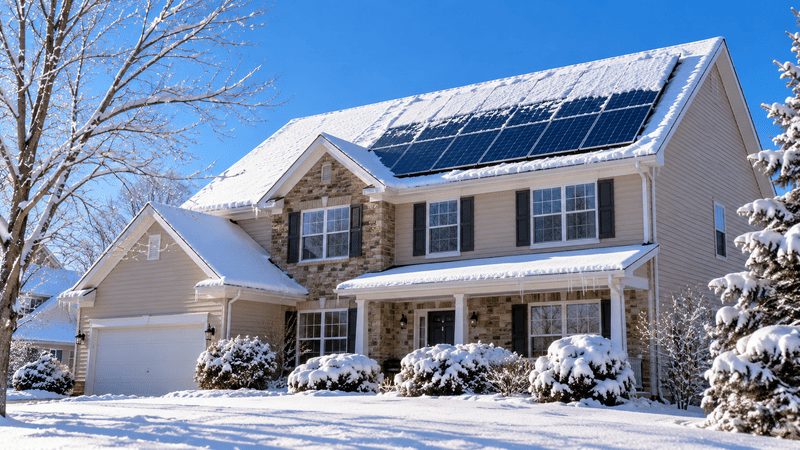
While snow is covering your panels, they produce little or no electricity. That part is obvious. But over a full year, the effect is much smaller than you might expect.
Research led by Sandia National Laboratories, working with Michigan Tech and other universities, has found that published estimates of snow-related losses range from about 1% to 12% of annual production, depending on location and weather. A Michigan Tech study of solar systems in snowy Ontario found losses of only about 3% to 5% per year.
In other words, even in places with far more snow than Cincinnati, Columbus, Louisville or Indianapolis, snow typically takes only a small bite out of a system’s yearly output.
Why Your Panels Usually Clear Themselves
Solar panels are surprisingly good at shedding snow on their own:
- They’re tilted. Most rooftop panels sit at an angle, so gravity helps snow slide off.
- They’re smooth. The tempered glass surface gives snow very little to grip.
- They’re dark. Panels absorb sunlight, which warms them and starts melting the snow from underneath.
- Once a little clears, the rest follows. As soon as part of a panel is exposed, it warms faster and speeds up melting.
Researchers have even found an upside: sunlight reflecting off fresh snow on the ground can give panels a small boost once they’re clear. And solar panels generally perform more efficiently in cold temperatures than in summer heat. (We bust that and other myths in 5 Misconceptions About Solar Power in the Midwest.)
Should You Remove Snow From Your Solar Panels?
For most homeowners, the best approach is to simply let the sun do the work. A typical Midwest snowfall will slide or melt off within a few days.
If you’d still like to speed things up after a heavy snow, here’s how to do it safely, and what to avoid.
Do:
- Stay on the ground. If you clear snow at all, use a soft-headed roof rake designed for solar panels with an extendable handle, and only on panels you can reach safely from the ground.
- Work gently. Pull snow down in light passes. Leaving a thin layer is fine; the sun will finish the job.
- Watch for falling snow and ice. Stand clear of the edge where snow will slide off.
Don’t:
- Don’t climb on your roof. Snowy, icy roofs are dangerous, and no amount of solar production is worth a fall.
- Don’t walk on or put weight on the panels.
- Don’t use hot water. A sudden temperature change can stress the glass, and the water can refreeze into ice.
- Don’t use metal shovels, ice scrapers or sharp tools. Scratches and pressure can damage the glass and cells.
- Don’t chip away at ice. Let it melt.
When in doubt, call your installer before doing anything that could damage your panels or affect your warranty.
Keep an Eye on Ice Buildup
Heavy snow that slides off panels can pile up at the roof’s edge or in gutters. If you notice large ice dams forming along your roofline, it’s worth having a roofing professional take a look. Ice dams can be a problem for any roof, with or without solar.
Winter Is a Small Part of the Solar Year
Winter brings shorter days and lower sun angles, so every solar system produces less in December than in June. That’s normal, and it’s built into how a system is designed. A well-designed system is sized around your home’s full-year energy use, so long, sunny days in spring and summer do the heavy lifting.
That’s why snow shouldn’t scare you away from going solar in the Midwest. Thousands of homeowners across Ohio, Kentucky and Indiana rely on solar year-round.
Worried About Winter Storms? Consider a Battery
The bigger winter risk for most homeowners isn’t snow on the panels. It’s ice storms and high winds knocking out power. Standard grid-tied solar systems shut off during outages for safety reasons, but a home battery can keep your essentials running. Learn more in Will Your Solar Panels Work During a Power Outage?
Why Homeowners Choose Icon Solar
Icon Solar has been designing and installing solar systems for homeowners across Ohio, Kentucky and Indiana since 2009. We design every system for real Midwest weather, from summer storms to winter snow, and we’re here to answer questions long after installation.
Learn more about solar for your home, see what our customers say in our testimonials, explore flexible financing, or check out our top 10 solar FAQs.
Get your free quote or call (866) 396-4266 to talk with our team.
Frequently Asked Questions
Do solar panels work when covered in snow?
Panels fully covered in snow produce little or no electricity. However, snow usually slides or melts off tilted, dark panels within a few days, and research shows snow typically reduces annual production by only about 1% to 12%, depending on location and weather.
Should I remove snow from my solar panels?
Usually, no. The sun and the panels’ tilt typically clear snow on their own. If you do clear snow, stay on the ground and use a soft-headed roof rake designed for solar panels. Never climb on a snowy roof.
Can I use hot water to melt snow on solar panels?
No. Hot water can stress the glass through sudden temperature change and can refreeze into ice. Let the sun melt snow naturally or use a soft roof rake from the ground.
Do solar panels work in cold weather?
Yes. Solar panels generally operate more efficiently in cold temperatures than in high heat. Winter production is lower mainly because of shorter days and a lower sun angle, not the cold.
Is solar worth it in snowy Midwest states like Ohio, Kentucky and Indiana?
Snow has a relatively small effect on annual solar production, and systems are designed around full-year energy use. Many Midwest homeowners rely on solar year-round.
Let It Snow
A snowy roof doesn’t mean your solar investment is on pause for the season. Let the sun do the work, stay safe on the ground, and enjoy the energy your system produces all year long.