Most people start shopping for solar in the spring, when the days get long and the sun feels strong. That’s understandable. It’s also a little backward.
If you live in Ohio, Kentucky or Indiana and you’ve been thinking about solar, December is one of the best months to get the ball rolling. Here’s why, and what the process actually looks like when you start in winter.
Yes, Solar Can Be Installed in Winter
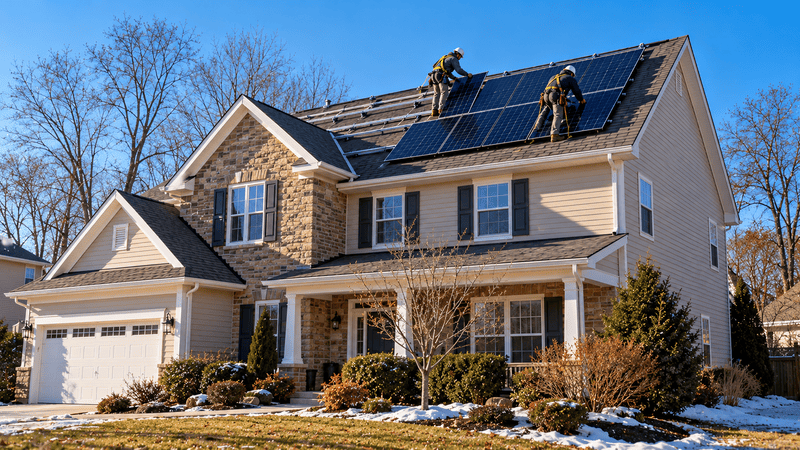
Solar installs happen year-round here. Cold temperatures don’t stop the work, and the equipment doesn’t care what month it goes up.
What does pause an install is a snowy or icy roof, heavy rain or high wind. Crews won’t work on a slick roof, so a winter install date may slide a day or two while we wait for a clear, dry stretch. That’s a scheduling detail, not a reason to wait until spring.
Installation Day Is the Short Part
When people picture going solar, they picture the crew on the roof. For a typical home, that part usually takes one to three days. Most of the calendar goes to the steps before and after:
- Site visit and design. We look at your roof, electrical panel, shading and past electric use, then design a system around it.
- Permits. Your city or county reviews the plans. Timelines vary by community.
- Utility application. Your utility reviews the system before it can connect to the grid.
- Installation. Panels, racking, wiring and inverters go in.
- Inspection. A local inspector signs off on the work.
- Permission to operate. Your utility gives the final OK, and your system turns on.
Put together, the whole process often runs two to three months. Some projects move faster and some slower, mostly depending on the local permit office and the utility.
The Timing Math: Start Now, Produce in Spring
This is where winter planning pays off.
Your solar system makes most of its power from spring through early fall. In Cincinnati, the shortest day of the year has about 9 hours and 25 minutes of daylight. By late June, that stretches to nearly 15 hours, and the sun rides much higher in the sky.
If you start in December, permits and paperwork move through over the winter, and your system has a good chance of being up and running as production climbs in spring. Start in April instead, and you may spend some of the best solar months of the year still waiting on approvals.
In other words, the months you’d “miss” by turning your system on in early spring are the lowest-producing months of the year anyway.
Other Reasons Winter Planning Makes Sense
- Your bills are front and center. Winter is when many households feel their energy costs most, and a full year of bills helps us size your system accurately.
- It’s a good time to look at your roof. If your roof is near the end of its life, it usually makes sense to replace it before panels go on. Winter gives you time to plan both projects in the right order.
- You can think through backup power. If storms have left you in the dark before, now is the time to decide whether a home battery belongs in your plan.
- More breathing room. Spring is when many homeowners call at once. Starting earlier gives you more time for questions and decisions.
What to Do This Month
If you’re curious about solar, here’s a short December to-do list:
- Pull your last 12 months of electric bills, or download your usage history from your utility’s website.
- Note your roof’s age and any known issues.
- Check whether your HOA has solar guidelines.
- Write down your goals: lower bills, backup power, or both.
- Request a free quote so we can look at your home and walk you through the numbers.
Learn More Before You Decide
Wondering what happens when winter weather hits your panels? Read Snow on Your Solar Panels? What Ohio, Kentucky and Indiana Homeowners Should Know This Winter. Worried about outages? See Will Your Solar Panels Work During a Power Outage? Thinking long term? Check out How Long Do Solar Panels Last? and Do Solar Panels Increase Home Value?
Icon Solar has helped homeowners across Ohio, Kentucky and Indiana go solar since 2009. Explore solar for your home, review solar financing options, read our guide to choosing a solar company, or request your free quote. You can also call us at (866) 396-4266.
Frequently Asked Questions
Can solar panels be installed in winter?
Yes. Cold temperatures don’t affect installation. Crews avoid working on snowy, icy or wet roofs, so install dates may shift a day or two for weather.
How long does it take to go solar?
The installation itself usually takes one to three days for a typical home. Permits, utility approval and inspections take most of the time, and the full process often runs about two to three months.
Is it worth turning on a solar system in winter?
Yes. Your system will produce less in December and January because the days are short. It will be ready for the much higher production of spring and summer, when solar does most of its work.
Should I replace my roof before installing solar?
If your roof is near the end of its life, replacing it first usually makes sense, so panels don’t have to be removed and reinstalled later. A solar installer can help you assess your roof’s condition.
What can I do to get ready for solar?
Gather a year of electric bills, know your roof’s age, and check your HOA’s rules. Having these ready helps the process move quickly.