Daylight saving time started this past Sunday, and suddenly it’s light out at dinner again. Solar owners are noticing something else, too: the numbers in their monitoring apps are starting to climb.
Spring is solar’s comeback season. It’s also the perfect time for a quick once-over of your system. The good news is that solar needs very little maintenance. Here’s what’s worth checking, what you can skip, and what’s normal as the days get longer.
First, a Quick Myth: Daylight Saving Time Doesn’t Give Your Panels More Sun
Moving the clocks forward shifts the daylight to later in the evening. It doesn’t add any. Your panels respond to the sun, not the clock, so your system’s daily production didn’t jump overnight on March 8.
What does matter is the season. Days have been getting longer since late December, and the sun climbs higher in the sky every week. In central Ohio, a June day delivers about 2.8 times as much usable sunlight to a solar panel as a December day. That’s why your production graph looks like a ramp from now through early summer.
Do Solar Panels Need Cleaning?
Usually, no. In our climate, regular rain does most of the cleaning for you. Dust and pollen do build up between rains, but the losses are typically small. In one model from the National Renewable Energy Laboratory, cleaning a system once a year reduced a 1.9% soiling loss to about 1.5%. That’s a small gain for a ladder and a hose.
There are exceptions. If your panels sit under trees that drop sap or heavy debris, are near a gravel road or farm field, or have bird droppings that don’t wash off, a cleaning may help. If so:
- Don’t climb on the roof. Hire a professional, or ask us.
- Never use a pressure washer, abrasive brushes or harsh cleaners. They can damage the glass and its coating.
- Check your panel warranty first. Some manufacturers specify how panels should be cleaned.
Your 15-Minute Spring Checklist
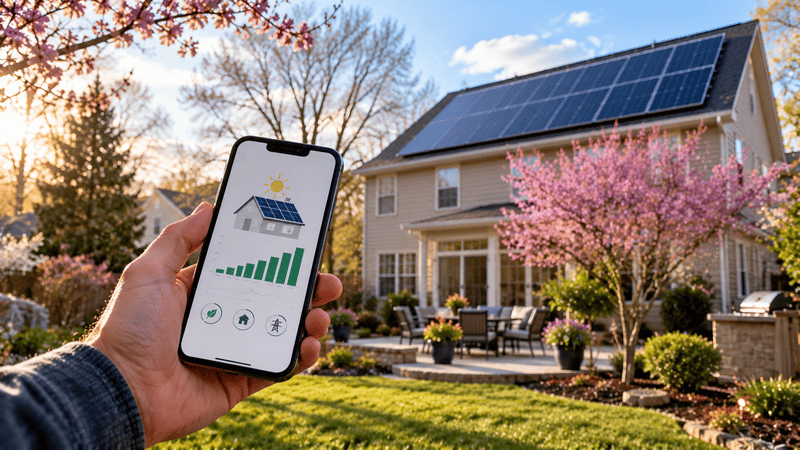
1. Check your monitoring app, and compare year over year.
Compare this March to last March, not to last month. Spring production should rise steadily. If you see a panel or section producing nothing on sunny days, or the system shows offline, give us a call.
2. Make sure your system is still connected to Wi-Fi.
One of the most common “problems” we see isn’t a problem with the panels at all. A new router or changed Wi-Fi password can knock your system’s monitoring offline. Your panels keep producing, but you can’t see it. Reconnecting usually fixes it.
3. Look over your panels from the ground.
After a winter of snow, ice and wind, take a walk around the house. Look for cracked or shifted panels, loose wiring hanging below the array, or debris like branches caught under the edges. If anything looks off, don’t climb up. Call us.
4. Plan ahead for spring leaves.
Trees that were bare all winter will leaf out over the next several weeks, and new growth can shade parts of your array. Spring is a good time to trim branches that are getting close. Hire a professional for anything near the roof or power lines.
5. Watch for nesting critters.
Spring is nesting season, and the sheltered space under rooftop panels attracts birds and squirrels. Signs include nesting material poking out from under the edges, droppings on the roof or noise overhead. Critter guards (a mesh barrier around the array’s edge) can keep them out. Ask your installer about adding them.
6. If you have a battery, check its settings.
If you raised your backup reserve or changed modes during winter storms, now’s a good time to set it back to your normal everyday mode.
What’s Normal This Spring
- Production that rises week to week as the days lengthen
- Big swings day to day. A cloudy, rainy April day can produce a fraction of a sunny one.
- Some days with surprisingly high output. Panels are slightly more efficient in cool, bright weather, so crisp sunny spring days can be some of your best.
What’s Worth a Call
- Zero production on a sunny day
- A panel or group of panels consistently producing much less than the others, without obvious shade
- Error alerts in your app that don’t clear
- Visible damage to panels, racking or wiring
Not a Solar Owner Yet?
Spring is a great time to look into it. Your system can be designed and installed in time to catch the long, bright days of summer. See how many solar panels your home may need, read whether solar panels damage your roof, and learn how long solar panels last.
Icon Solar has helped homeowners across Ohio, Kentucky and Indiana go solar since 2009. Explore solar for your home, review solar financing options, or request your free quote. Current customers with questions can call us at (866) 396-4266.
Frequently Asked Questions
Do solar panels need maintenance?
Very little. A quick seasonal check of your monitoring app and a look at your panels from the ground is usually enough. Call your installer if you see damage, alerts or a sudden drop in production.
Do solar panels need to be cleaned in Ohio, Kentucky and Indiana?
Usually not. Regular rain keeps panels reasonably clean, and losses from dust and pollen are typically small. Cleaning may help if your panels collect sap, heavy debris or bird droppings.
How should solar panels be cleaned?
Hire a professional rather than climbing on the roof. Never use a pressure washer, abrasive brushes or harsh cleaners, and check your panel warranty for the manufacturer’s cleaning guidance.
Does daylight saving time increase solar production?
No. Daylight saving time shifts daylight to later on the clock but doesn’t add sunlight. Production rises in spring because days get longer and the sun climbs higher.
How do I keep birds and squirrels out from under my solar panels?
Critter guards, a mesh barrier installed around the edge of the array, can keep animals from nesting underneath. Ask your installer about adding them.