
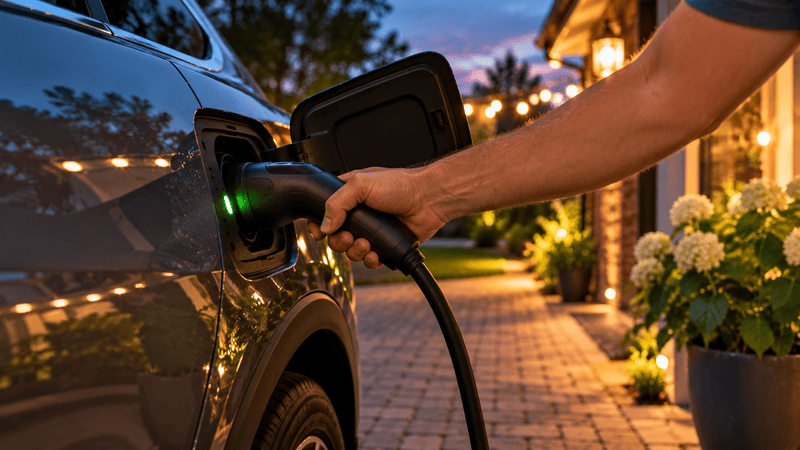
More and more homeowners we talk to either have an electric vehicle already or expect their next car to be one. That leads to a great question: “If I go solar, can my panels charge my car?”
They can. Here’s how much solar it takes, with real numbers, plus a few things about timing and utility rules that make a big difference in how much you save.
Step 1: How Much Electricity Does an EV Use?
EVs are rated by how many kilowatt-hours (kWh) they use to go 100 miles. Most use somewhere around 25 to 40 kWh per 100 miles. Smaller, efficient cars sit at the low end, while large SUVs and electric pickups use more.
The average American driver covers about 13,500 miles a year. A typical EV driven that far uses roughly 4,000 kWh, plus some energy lost during charging. Call it about 4,500 kWh a year.
For comparison, the average Ohio home uses about 10,150 kWh a year. Adding an EV can increase a household’s electricity use by 40% or more.
Step 2: Turn That Into Solar Panels
In our region, each kilowatt (kW) of solar produces roughly 1,150 kWh a year, the same figure we used in our guide to how many solar panels you need. Using 400-watt panels, here’s what it takes to cover a year of charging:
| Driver type | Miles per year | EV efficiency | Charging energy per year* | Solar needed | About how many 400 W panels |
|---|---|---|---|---|---|
| Light driver, efficient car | 10,000 | 28 kWh/100 mi | ~3,100 kWh | ~2.7 kW | ~7 |
| Average driver, typical EV | 13,500 | 30 kWh/100 mi | ~4,500 kWh | ~3.9 kW | ~10 |
| Average miles, electric truck or large SUV | 13,500 | 45 kWh/100 mi | ~6,700 kWh | ~5.8 kW | ~15 |
*Includes about 10% for energy lost during charging.
So for most drivers, covering your EV takes roughly 7 to 15 more panels on top of what your home needs.
Timing Matters: Most EVs Charge at Night
Solar panels produce during the day, but most people plug in when they get home in the evening. How that works out depends on your utility’s rules:
- Ohio: Utilities offer net metering for customer-owned solar. Excess daytime solar earns credits that offset electricity you use later, though credit rules vary by utility.
- Louisville and Lexington (LG&E and KU): Excess solar earns a bill credit, but it’s worth less than the retail price of electricity. More on that here.
- Indiana investor-owned utilities: Under Indiana’s EDG rules, excess solar is credited as it leaves your home at a rate well below retail. Here’s how EDG works.
The takeaway: the more of your charging that happens while the sun is up, the more you save, especially in Kentucky and Indiana. A few ways to make that happen:
- Charge during the day when you can. If you work from home, use a second car for commuting, or are home on weekends, schedule charging for late morning through mid-afternoon.
- Use your charger’s or car’s scheduling features. Many EV chargers and cars let you set charging windows. Some can even follow your solar production.
- Add a home battery. A battery can store midday solar and use it in the evening, including for charging, and it doubles as backup power during outages.
Before You Add an EV Charger
A few practical points:
- A Level 2 (240-volt) charger is what most EV owners install at home. It’s much faster than a standard outlet.
- Check your electrical panel. An EV charger is a large new load. Some homes need a panel upgrade, especially when adding solar, a battery and an EV charger together. It’s smart to plan all three at once.
- Size your solar for the future. If an EV is in your plans in the next few years, tell your installer. Designing for it now is easier than adding panels later.
A Note on Rising Rates
With electricity prices climbing across our region (we’ve covered Ohio’s June increases and grid capacity costs through 2029), adding an EV without solar means buying more electricity at those higher prices. Charging from your own panels keeps more of your “fuel” cost under your control.
Plan Your Solar, Battery and EV Together
Icon Solar has helped homeowners across Ohio, Kentucky and Indiana go solar since 2009. Whether you already drive electric or expect to soon, we’ll size your system around your home and your driving.
Explore solar for your home, learn about the Franklin WH home battery, Enphase and Tesla Powerwall, review solar financing options, or request your free quote. You can also call us at (866) 396-4266.
Frequently Asked Questions
How many solar panels does it take to charge an electric car?
For an average driver covering about 13,500 miles a year in a typical EV, roughly 10 extra 400-watt solar panels in Ohio, Kentucky or Indiana. Lighter drivers may need about 7, while electric trucks and large SUVs may need about 15.
How much electricity does an EV use per year?
A typical EV driven about 13,500 miles a year uses roughly 4,000 to 4,500 kWh, including charging losses. Larger EVs and electric trucks can use 6,000 kWh or more.
Can solar panels charge an EV at night?
Not directly, since panels only produce in daylight. Depending on your utility, excess daytime solar may earn credits that offset nighttime charging, or a home battery can store solar for evening use.
Do I need a battery to charge my EV with solar?
Not necessarily. Daytime charging or utility credits can cover much of it. But in places where excess solar is credited below retail, like Indiana and Kentucky, a battery can help you use more of your own solar.
Should I install solar before or after buying an EV?
Either works, but if an EV is in your plans, tell your installer so your solar system and electrical panel can be sized for it from the start.