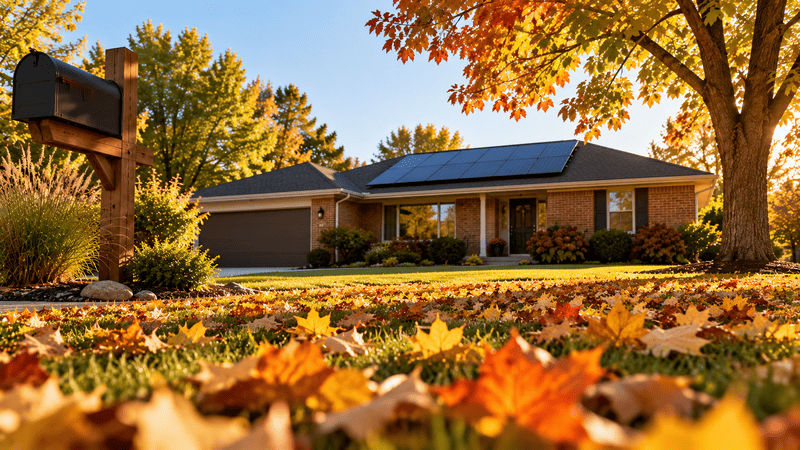
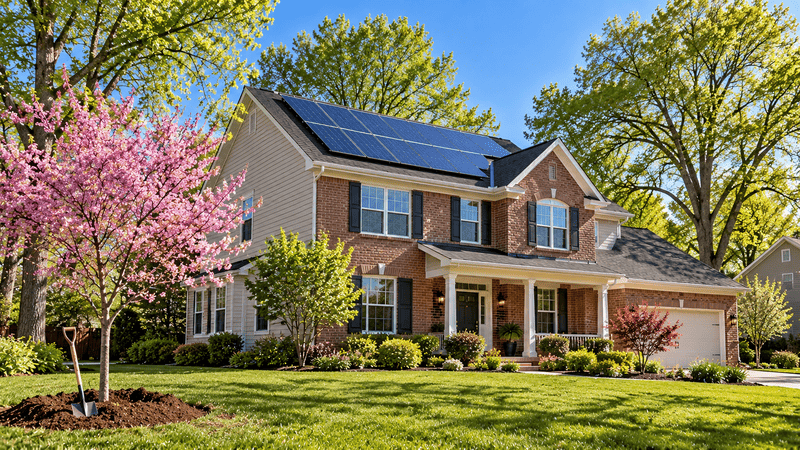
Today is Arbor Day, and here in Ohio, Kentucky and Indiana, we love our trees. Mature oaks, maples and sycamores are a big part of what makes our neighborhoods feel like home.
They’re also one of the most common reasons homeowners assume they can’t go solar. “My yard is full of trees” is something we hear all the time.
The good news: trees and solar can often coexist. Here’s how shade actually affects solar panels, when trimming makes sense, and how to plant smart for the future.
How Shade Affects Solar Panels
Solar panels need direct sunlight to produce at full power. Shade reduces output, but how much depends on more than just how many leaves are in the way.
Shade can have an outsized effect. Inside each panel, cells are wired in groups. Shading even a small part of a panel can switch off a whole group of cells. On many panels, that’s about a third of the panel’s output.
Your inverter setup matters, too. In a traditional “string inverter” system, panels are wired together in a series, so one shaded panel can drag down the output of the others in its string. Systems with microinverters (like Enphase, which we install) or power optimizers let each panel work independently. A shaded panel produces less, but it doesn’t hold back the rest.
That difference is real. In a side-by-side test by the National Renewable Energy Laboratory (NREL), a microinverter system produced 3.7% more energy than a string inverter system under light shade, 7.8% more under moderate shade, and 12.3% more under heavy shade.
Timing Matters: When the Shade Falls
Not all shade costs the same:
- Midday shade hurts most. Panels produce the most from late morning through mid-afternoon. A tree that shades your roof at 8 a.m. matters far less than one that shades it at 1 p.m.
- Leafy trees change with the seasons. A deciduous tree that blocks summer sun lets more light through in winter after it drops its leaves. Branches still cast some shade, though.
- Winter shadows are long. In the Cincinnati area, the sun at noon on the shortest day of the year sits only about 27 degrees above the horizon. That means a tree casts a noon shadow nearly twice as long as it is tall. In late June, that same tree’s noon shadow is only about a quarter of its height.
A good solar design accounts for all of this. During a site visit, we measure shading across the whole year, not just on the day we’re there.
Do I Have to Cut Down Trees to Go Solar?
Usually not. Often the answer is somewhere in between:
- Selective trimming. Removing a few branches that shade the array during the middle of the day can make a big difference without losing the tree.
- Smart panel placement. Using the sunniest sections of your roof, even if it means fewer panels, can beat covering a shady roof.
- Ground-mounted solar. If your roof is shaded but you have open yard space, a ground-mounted array can be placed where the sun is.
- Sometimes, solar isn’t the right fit. If your roof is heavily shaded most of the day and there’s no good alternative, we’ll tell you. We’d rather lose a sale than install a system that won’t perform.
Keep in mind that shade trees have value of their own, including cooling your home in summer. Taking down a healthy tree is a decision worth thinking through, and never a requirement for working with us.
After a stormy April: It’s been a rough month for severe weather across our region. If you have large trees near your roof, solar or not, have a certified arborist check for cracked or hanging limbs. A damaged branch over your roof is a risk to shingles, gutters and panels alike.
Planting New Trees? Plan for Your Panels
If you already have solar, or plan to, a little planning on Arbor Day can save you trouble 15 years from now:
- Plant tall trees on the north side of your home, where they won’t shade a south-facing array.
- Think about mature height, not planting height. That cute sapling may be 50 feet tall someday. Check the tag before you dig.
- Use smaller ornamental trees closer to the south side. Dogwoods, redbuds and serviceberries stay modest in size.
- East and west plantings can work if they’re far enough from the house. They can shade windows on hot afternoons without blocking your roof at midday.
- Account for winter shadows. Remember that winter shadows can be nearly twice a tree’s height at noon.
Get a Real Shade Assessment
Every home is different. The only way to know how your trees affect solar is a proper site assessment.
Icon Solar has been designing systems around Midwest trees since 2009. Learn how solar panel sizing works, check our spring maintenance checklist, explore solar for your home, or request your free quote. You can also call us at (866) 396-4266.
Frequently Asked Questions
Can I get solar panels if I have trees?
Often, yes. It depends on how much direct sun your roof gets, especially from late morning to mid-afternoon. Selective trimming, smart panel placement, microinverters or a ground-mounted system can make solar work for many homes with trees.
How much does shade reduce solar panel output?
It varies. Even partial shade on one part of a panel can switch off a group of cells. In string inverter systems, one shaded panel can reduce the output of others. Microinverters and optimizers limit that effect.
Do microinverters help with shade?
Yes. Microinverters let each panel operate independently. In NREL testing, a microinverter system produced 3.7% to 12.3% more energy than a string inverter system, depending on how much shade was present.
Do I need to cut down trees for solar panels?
Not usually. Trimming a few branches or placing panels on the sunniest parts of your roof is often enough. Healthy trees also provide summer shade for your home, so removal should be a careful decision.
Where should I plant trees if I have solar panels?
Plant tall trees on the north side of your home, use smaller ornamental trees nearer the south side, and always plan for the tree’s mature height and long winter shadows.